| view Scribd version (PDF) | |||||
To
Dance Life Rick Dolphijn
SCENE I 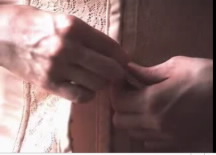
In Das Partes
for Video (Zurita, dir. 2007) the young Brazilian artist Veridiana
Zurita offers us a threefold movement. The first scene is a proper introduction
in which we are offered a human body – a female human body, as we
call it. We can also call it a monad (after Leibniz), or a whole, a
World. The body is not topped or surfaced with a face but with a mask
that stands still and allows the camera to start its observation. It
is the surface to be inscribed. It is an invitation. The camera scans
its “reflecting, immobile unity” in order to find the “intensive
expressive movements” (Deleuze, 1983 [1986]: 87) as they constitute
affect together. It searches for what is yet unseen, for the dark and
the obscure. At this stage it pays little attention to the mouth, which
is sealed off by a mask. It is much more interested in the womb. Or
at least, that is where the camera is taking us. Two hands start peeling
off a series of meat-colored corsets, willingly accepting the camera’s
pornographic (as Haraway would call it (1988)) urge to search for an
inside, for how the outside surfaces fold in, creating the screen upon
which our world can be projected. The camera, as always, is a sadist,
with the eternal desire to separate a whole into parts. It is a mechanistic
instrument, that, although able to move in all directions, is itself
only interested in zooming in, as Eisenstein has told us so often. For
is it not strange that zooming out only takes place at the end (sometimes
of a scene, mostly of a film)? Zooming out is the restoration of the
romantic ideal. It has nothing to do with art, with aesthetics. Quite
the opposite, it upholds the idea of representation, of the doubled
world which we are now about to leave. This camera is honest, true.
It knows that its only way is to the inside, into the world. When the last
corset is removed, the camera has arrived at its final frontier: the
living skin. Once covered up, given a façade by the lifeless corsets
intended to provide the body with an identity (sexual, cultural, social),
with a structured and captured self that finds itself in opposition
to the outside that it escaped, the skin always already re-moves the
images projected into it. It shows itself as a most unstable surface,
nervously in movement because of breathing, because of the muscular
structures that connect it to the various living bodies its houses,
and most of all because we all know that the skin is much more than
an organ of the body. The skin is the fold to the nth degree. The skin desires the out to come in and the in to go out. The
skin, upon closer inspection, is a Sierpinski carpet that seems to be
a surface, or, in terms of the body it surrounds, a volume. But it is
covered with holes that are surrounded by other holes ad infinitum,
making its total surface/volume approach zero. By undoing the body of
its harnesses (corsets) and by zooming in upon the ongoing metamorphoses
of the skin, the camera, as ever, searches “to withdraw into the recesses
of a world” (Leibniz, quoted in Deleuze [1988] 1993: 9). We approach
the skin infinitely closely. Darkness encloses us. The (phallic) camera
folds itself into the belly, the navel, the centre of the world. SCENE II
The inside of
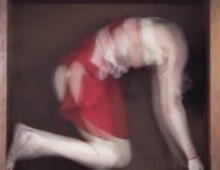
the belly, the womb, equals a square made of wood. This is what the
second scene tells us. And there is a woman inside it – unmistakably
a woman, of course. But this time the mask does not capture her, signifying
the way her body is held captive, enclosing and molding it into a defined
set of expressive traits. There is a mask involved, but its function
is entirely different from how it (together with the corsets) acted
in the first scene. Now the mask is made up of a cluster of heads, with
all sorts of facial expressions. It also leaves the mouth uncovered.
Sometimes the dancer extends her head with an artificial leg. Even more
so than in the first scene, we are reminded of the monstrous births
that still haunt the female body. Or, in more contemporary terms, the
teratomas, as Stacey mentions them: “cancers of the germ cell (the
egg or the sperm), [that] mimic ‘the beginning of life’ with apparently
authentic authority” (Stacey, 1997: 91). Or the deviant fetus that
threatens the body of the mother, yet is unmistakably produced by it,
a part of it. Braidotti adds to this that “the constitution of teratology
as a science offers a paradigmatic example of the ways in which scientific
rationality dealt with differences of a bodily kind” (Braidotti in
Stacey, 93). This deformity, this abnormality which is of the female
body, turns grotesque in the stage version of Das Partes (which is a name the artist chooses to give to a series of processes
and not to this particular project). Here, the extension of the head
has not only itself grown spectacularly (reaching to the ceiling of
the theatre, easily ten meters), it also seems to have over-coded her
entire body with a cluster of limbs and faces. The extension then almost
suffocates the dancer with its weight and its dangerous rotations, turning
movements into spasms that only show us the impossibility to get away
from how the enormous space allows our body to extend itself, in the
end crushing it under its weight. It is the End of Man. Let us take a
closer look at the way in which Zurita performs the monstrous female
homunculus; how her dance proposes a vitalist critique of scientific/Cartesian
dogmas. Let us follow for a moment the movements expressed by the dance,
and then in particular the way in which they allow us to escape from
the strategies of power, the discourses Zurita plays with. To start
we should keep in mind that, in line with Foucault’s late writings,
the earthly wooden square is the heavenly elastic circle that does not limit the dancer in the way
she moves but rather opens up a (spatial/spatiotemporal) way of being
(creating a topological rather than a geometrical space). Refusing the
anthropocentric perspective, we should thus not start our analysis by
stating that the dancer moves or dances inside the cube. Rather,
it is with the cube that the dance takes place, as everything
acts in its togetherness. The infinitely hollow surface/volume with
which the camera confronts us does not function according to the idea
that two outsides of bodies can be related to one another. Rather, it
functions through enfolding. It shows us that movement never takes place
on the outside of a body, but comes from within, from how the body,
that is always multiple, and has the greatest depths, unfolds itself
with the camera. The sadistic camera that is capable of opening up a
threshold of perception, once more allows for a multitude of com-pli-cations,
du-pli-cations and re-pli-cations that create the morphogenesis of the
real. The body in the
box becomes a cell, a molecule that does not “contain” but that
is always already as a whole created in the dance. This (per)formance once again shows us that dance is not about the body and how it expresses itself. Nor is dance about the sense (meaning) released by a body, as
Colebrook seems to ascribe this idea to Deleuze (2005: 12). Ascribing
dance to a body still presumes the existence of an Aristotelian
body with particular bodily traits and possibilities (not virtualities)
that are considered qualities of this body before the dance takes
place. We claim however that it is through dance that bodies
are created. We say that dance is about the play of forces as it creates
the sensations through which bodies of the performer, of the cube, of
the spectator, and of all of them together (there is no reason to believe
that particular pleats of matter cannot be part of several bodies at
the same time) are being formed. That is what dance is about – the
creation of the singular body/bodies in correspondence with the singular space/spaces (and time/times, as we will find out later). This must be the
reason why Zurita chose to name a series of performative experiments Das Partes. Das Partes (from Portuguese to English) should
be transcribed “from or about the parts”. It refers to the various
performances, to the parts of which they consist, but of course most
of all to how in the dance the partiality of the objects, the
unformed matters about to be mater-ialized, about to be in-volved, is
always already at stake. It first of all seems to propose a type of
performance in which an inside, folded from an outside, is created as
an immanent intraconnected set of series. Thus we should not have talked
about an extra leg, as if added to an already existing head, or a series
of limbs and body parts as if they were “extra” to the body of the
dancer. Starting with force or movement, with a Bergsonian Élan
vital, we should rather have set to mapping how new conglomerates,
new bodies of bodies, come into being in the event. This is why Manning
starts her book Relationscapes by stressing that: “There are
always two bodies” (2008:13) when it comes to a dance. At least two
bodies, never one, and it is always relational movement that is involved.
Thus, we should set ourselves to opening up to the intensities as they
come about between the bodies, creating a zone of life that is relayed
with the various tactics and their consequent enfoldings through which
the performance enters processes of movement. Taking all this
into account, what can we say about whatever does happen in this
second movement? How can we conceptualize the particular (or singular)
dance in this scene? How is dance at work in this particular performance?
How is the Aristotelian definition of dance, still the most dominant
conceptualization of dance as Colebrook (2005) rightfully claims, that
searches for the origin of the dance the body of the dancer (the developed
potential to dance inherent to a body), put into question in this particular
performance? Important to the
creation of the strings of movements here is the fact that this event
has a stutter. It is not a stutter in language. It is not the
creation of an extra tongue that fights the imposed major language,
as Sneja Gunew speaks of it (2004). It is not a political linguistic
but rather a materialist aesthetic stutter. It allows both the imagery
and the music to open up an oblique four-dimensionality in which hesitation,
fear, desire, chance and power are produced through a returning pleat
creating non-chronological streams. The pleats slow these streams down
and speed them up, yet unlike the razor-sharp stroboscobic bits that
make up the video art of Antonin de Bemels (see de Bemels, 2009) which
seem to accelerate movement increasingly, Zurita allows for a taking
back and forth of movement, creating continuous gushes on either side
surrounded by its extremes (we can refer to them as helicoidal movements). In search of the
dynamic combinations in this ongoing disequilibrium, the stuttering
surfaces and temporalities, volumes and soundscapes, do not create a
(harmonic) parallelism but more or less evoke one another in the stutter, which then sets into movement a non-synchronal rhythm that
pushes the performance forward. The predominantly cinematic and audiovisual
rhythmic contents, are doubled by this rhythm that, in its stapling,
forms the helices, the multiple dances, that only due to our simplest
narratology, can be considered as one, the one total linear movement.
The various stutters thus seem to be caused by the way the imagery and
the music are constantly decomposing the composition enacting a multiplicity
of microdances that overlap one another creating a texture, a
corrugatedness. This way a “synesthesia proper to vision” creates
a visual touch, as Massumi (2002: 158) names it, followed and preceded by a “synesthesia proper to hearing” that creates audible
touch. It makes good sense to use Deleuze (and Guattari)’s concept
“the haptic” (Deleuze, [1981] 2003) to catch what these textures
express, how the stutter itself is a sensation. The stutters thus work
like the individual (static) overlapping scales of the fish that speed
up the movements taking place between the fish and the water, separating
the substance of the fish from the substance of the water. Enfolded within
these rhythms are the spatio-temporalities of relation. To unravel these,
we should not look at the performance in terms of it primarily being
created by the anomalies of speeding up and slowing down. Now we focus
on the images and the sounds as a system of relationships between its
elements-to-come, creating forms of succession and of extension. These
forces make up the two vortices central to the analysis of dance. That
being said, the first thing to agree upon in respect of our second analysis
is that these particular dances by no means reflect a series of studied
movements, of steps, of positions memorized and stored inside a body.
Instead the body of the dancer opens up to those particular machinic
procedures that the dance, the event, proposes. It is invited to act
beyond the pure empirical succession of time (the chronological choreography),
much more interested in an introspection of coexistence and how that
comes about. Thus when the hand follows the walls of the cube, it is
not according to a preset bodily ideal that the dance proceeds: a new
relation emerges where the entire body of the dancer and the cube are deterritorialized and undergo a metamorphosis. Manning adds to this:
“As the bodies qualitatively metamorphose, so does the relation between
the form and matter of these bodies” (2004: 89). What happens in the
dance is therefore a deterritorialization of everything that
makes up the body of the performer, of the cube, and of everything else
somehow at work in the event, in all their virtual relations. Instead of departing
from the dogmas of dance, Zurita therefore enacts dance worthy of the
event. It reveals to us the two concepts that Whitehead came up with
that allow us to map what happens in the event, situation and ingression.
The first calls attention to the way matter is involved (being formed)
in the event, how the forces in it allow for connections to take place.
The second then focuses on how this connection allows the meanings (in
the widest sense of the word) to flow into one another. Any matter (or
the “object” as Whitehead calls it, or the various “parts” as
Zurita refers to) then “has different modes of ingression into different
events” ([1919] 2007: 119). The dance explores whatever forms and
metamorphoses of these matters involved can take place, how they can
affect/deterritorialize and create one another, drip into one
another. Only by allowing
dance to be worthy of the event do the bodies involved set themselves
to an infinite creation of a space-time manifold. Do not criticize
this by claiming that a body when captured in a cube is not able to
stand up, to stretch in full, to walk or to run. We should not think
of the body outside of its situation as a premise of all bodily action,
as Merleau-Ponty taught us a long time ago (for instance, 1945: chapter
1). Neither should we ascribe all kinds of qualities to “a cube”,
as if it is a ready-made, static entity simply placed into a performance
(and taken out again). Let us not fall back into this Kantian/Cartesian
idea of space and time as already existing categories that locate and
capture life in four dimensions. Let us accept that “[we] are caught
up in the world and we do not succeed in extracting ourselves from it
in order to achieve consciousness of the world” (Merleau-Ponty, 1945:
5). And if we cannot extract ourselves, we should certainly not extract
a cube, an Other, from the world, as Derrida so often told us. Let us
accept that the living subjects and the lived objects come to life in this situation, in this performance. The microdance that we are
conceptualizing here then in the end proposes a thorough anti-dogmatism
that always already starts with, as the Argentinian pop group the Babasonicas,
in their song “Microdancing”, keep repeating: “No esperes nada de mí, no esperes nada de mí (Do not expect anything from me, do not expect anything from me)”
(2008). For, instead of expecting, of projecting our ideals onto the
real, we should map the speeds-and-slownesses that give form to the
contents and expressions that are the event. Our view in the
belly is kaleidoscopic as one microdance always already invites the
next, creating an infinite enfolding of movements in the smallest possible
circuit. It is a kaleidoscopic machine as it constantly staggers from
one moment to the next or to the previous. We notice that there
is a crack in the world, as Murakami’s Nakata put it so eloquently
in Kafka on the Shore. The minor movements, the smallest gestures
that the camera reveals to us, present us with the fractal nature of
space that, in magnifying even the infinitesimal, creates new forms
of expression, new blocks of sensation ad infinitum. The
continuous questioning of all the relations at stake poses all sorts
of questions. Because of the ever changing intrarelations, the dancer
can turn from a dwarf into a giant in the shortest period of time, or
into an animal, or into a ghost. This is not because the body itself
of the dancer is capable of creating a metamorphosis, but because of
the relations at work in the dance. Because of the
ongoing metamorphosis that makes up this performance, which in no way
finds its origin in the human being, the big questions (in micro format)
that haunt this second scene especially, deal with how this move away
from humanism is being established. Actually at the start of this scene,
where the dummy-like figure of the first scene allows us to enter its
world though the belly, the navel, Leonardo Da Vinci’s Vitruvian man,
that canonical image that can be found at the heart of humanism, as
it dominated thinking in the Western world for such a long time, immediately
joins the experience. Inspired by the architectural writings of Vitruvius
and in particular his idea that the ideal human figure was the principal
order of proportion in all classical thoughts on form, Leonardo suggests
capturing this geometrical ideal in the two positions that make up the
Vitruvian man. In reference to his artwork, his (few) writings even
further explicate the profound anthropocentrism we see at work here.
The very first sentences of his Paragone, his (edited) philosophy
of art, focus on the idea that science, geometry for instance, begins with the surface of the bodies that has its origin in the line, the
border of that surface. Clearly making reference to Vitruvius’ De architectura (written circa 27 BCE) (Vitruvius 1931: 3.1.2–3),
Leonardo’s (perfect) triangle between art, science and truth represents
the anthropocentric harmony of forms that starts from the human contours
and that has enjoyed such great popularity in modern times. Leonardo’s
image is part of the same Modernist discourse as Vitruvius’ ideas
and the way they set themselves to “establish the true rules
of the beautiful and the perfected in buildings”, as the famous physiologist,
architect (of a part of the Louvre) and translator of Vitruvius (commissioned
by Colbert), Claude Perrault, argued (in Brodsky Lacour, 1996: 135).
Framed by heaven (the circle) and earth (the square), the Vitruvian
man can very well be seen as the fulcrum of all Modernist form. From
the ideal anthropocentric point – the navel – all spatiality has to be thought. Yet whereas Leonardo considers the navel to be the point from which the world unfolds itself, Zurita considers it the point at which enfolding takes place. It is not an extensive zone that is created from it and opposed to it, but an intensive zone in itself. Thus, in contrast to what Leonardo does, this performance does not define man, nor heaven, nor earth. It is not ideal, not even modern. It makes no distinction between the circle and the square or between heaven and the earth. The belly/the womb, as she stages it, is both the circle and the square, relative to its use. It is both heaven and the earth as the forms do not follow from the human body, projecting its form onto the world, but are created by the flows of the event, by its intra-active movements. Instead of enveloping the anthropocentric space of Vitruvius, as Leonardo does, Zuritas’ non-humanist spaces thus seem to the way in which a contemporary architect like Koolhaas conceptualizes his notion of BIGNESS. Koolhaas too intends to allow for an uncomfortable dimensionality that is not ideal or modern. He aspires to mobilize architecture’s full intelligence by allowing buildings to grow beyond the (human) imaginable. Not subscribing to what he calls “the humanist expectation of ‘honesty’” (1994: 501) as it supposes a transparency and a rational logic, Koolhaas’ BIGNESS deliberately seeks an accumulation of the mystery. In a similar way, Zurita creates what we might call a smallness. An infinite uncomfortable smallness, mystifying the body of the dancer by confronting it with situations it has never been confronted with before. Once again, the performance proves itself to be sadistic. This time it is not because of the perverted camera that set itself to the unravelling of the human body. Here, it shows that the body was de-organizing itself all along, always already questioning its (modernist) identity, breaking it into pieces even more. SCENE III 
All of a sudden
the dancer is confronted with a dummy of a female body, and immediately
throws herself at it. Instead of critiquing sexual difference, anthropocentrism
and subjectivity, in which the codes and signs and powers are being
questioned, Zurita now moves to an affirmation of sexual differing,
to a philosophy of the pure event, to desire or appetite, in which affects,
forces and an absolute instead of a relative metamorphosis create the
performance. This time there is no search for an inside of the body,
a biological essence, a gender or a humanity. The third scene offers
us the body of the dancer in more or less the same position from which
the performance started (again stressing the (fractal) self-similarity
of the whole project). Yet now, the entire performance is reterritorialized
upon the mouth. Replacing the Vitruvian navel as the centre from which
the world unfolds, the mouth offers us a new way of thinking about humanity
without opposing the inside to the outside, thus there is no need to
“undo” our humanist legacy (as, for instance, Butler proposes this).
Without having as the ideal to unfold the world according to the contours
of the human body, or having to critique it, the mouth opens up the
inside and the outside, the subject and the object, allowing
us to start from between. The mouth then rewrites humanity from the
point of relationality. The last and no
doubt most enigmatic scene thus offers us the mouth. Here, the fragmented
body, consisting of two-dimensional plaques of skin and doll parts,
is pressed in to create a new whole, a new body, which is immediately
torn down again. The pieces are being chewed upon as well, or better, danced with by the soft circle/square of the mouth, through what
is not even a microdance anymore, but a nanodance… This is what Brazilian
performance artist Lygia Clark’s call to structure the self is all
about. It is a call for a non-humanist nativity. It is a creation of
life, which has to take place in the dark. In the obscure,
in the hidden. That is why the experimental Jews’ harp group, Trio
Aubergine, considers its music subterranean; because it is in the mouth,
in the unknown, that they allow their instruments to create a mechanical
expression of the cavities of the head into the great outside which
is not outside anymore. The vital one, the most undefined and flexible
cavity being of course, the mouth. Lygia Clark herself
once had a dream in which an anonymous substance was churning out of
her mouth, leading to the loss of her inner substance. It is the End
of Man. She turned this into what would probably be one of her most
well-known performances, Baba Antropofágica. In it, the participants
who used to be mere observers (in this case, students of hers at the
Sorbonne where she taught for a while), placed small spools of colored
thread in their mouths, unwinding them directly onto another of the
participants who lay on the floor. We can translate Baba Antropofágica as “Cannibalistic Drool” – the collective vomiting of lived experience
which was then swallowed by others, as she herself must have described
it (Osthoff, 1997: 283). Creating bodies from bodies, by eating them,
by dissolving them through the mouth. Life should be
situated in the mouth in the first place. Contrary to popular belief,
life is not a very mystical concept. In his Modes of Thought ([1938]1968: 151-2), Whitehead named life’s three characteristics,
which reminds us a lot of how Spinoza had already defined it a few centuries
earlier. First Whitehead identifies a need for self-enjoyment, which
Spinoza would define as a perseverance of being which he also considers
the essence of every (multiple) body. Then, he comes up with the notion
of creation which allows the constant construction and destruction of
unities, which Spinoza captures with the twin terms joy (=creation)
and sadness (=destruction). Finally, Whitehead introduces “aim”,
which is about selecting and projecting “the boundless data” in
this process of unification, which Spinoza defines with affect and affection. Even more so than
with Lygia Clark, the third part of Das Partes for Video is about
the creation of life. With Zurita too, the dancing of the body parts
in the mouth is also accompanied by drool. This time, however, the drool
is not represented by colored threads. This time there is no obvious
reference to a Freudian Dream. This time, the drool has to emerge from
the dancing, from the movements themselves: they do not take place in the mouth, but they do in a sense create the mouth. This third
scene then rewrites the second scene not so much by turning it inside
out, which would imply that the organic (the body of the dancer) and
the inorganic (the box, the dummy, the plastic body parts) have switched
places. On the contrary, the third scene bears the same genetic algorithm
as the second. Its morphogenesis is one of topological (scholastic)
self-similarity in which the drool proves able to reveal life as
a necessity of the micro- or nanodance. Clark has said that her
performances were by no means pleasurable. Here, with Zurita, the pain
that comes with the loss of inner substance, expressed by the drool,
is accompanied by the pleasure of creating an inner substance, creating
the impossible. For now we see the subterranean, Heidegger’s earth,
as the various micro- or nanodances assemble the body from the various
parts that dance the mouth. Even more so than with the second
scene, this scene (per)forms life as it shows us its origin, the locus
where it is both destroyed and created – the mouth… that drools. There is definitely
something Brazilian about this. Let us not refer to it as postcolonial,
not only because of its prefix which supposes a kind of linearity to
come (as Lyotard put it ([1988] 1991)), but also because it comes with
a kind of non-situatedness, a strange kind of abstraction that takes
us away from the lived. Clark’s work, together with that of Helio
Oiticica, definitely experimented with the real and did so in such a
way that the soil, the abovementioned subterranean, needs to have a
crucial position when we conceptualize their work. And when we see a
notion of “Brazil” popping up in their performances, this does not
necessarily mean that they define a country (although much more pop
and less radical, the Argentinian group Babasonicos might be interested
in similar processes as they too are interested in drool, a sonic drool
in this case). Brazil is then a much more general flow that is realizing
and actualizing itself in all sorts of situated statements and material
arrangements. Although also
definitely interested in the body, Clark’s anthropophagic vomiting,
especially as it captures an-Other human body is a political manifesto,
whereas Zurita’s drooling microdance is a purely aesthetic experiment.
It is relative movement as opposed to absolute movement. It is a body
politics instead of a desire to find out what the mouth can do. Clark,
like Gunew, is in search of a second tongue, a subterranean otherness
that resists the force feeding of the mother, as it is enveloped (in
later life) with language (see Gunew, 2005). Clark thus has to vomit, has to get the intruder (the food, the language) out of her
body in order to cleanse herself. In her correspondence with Hélio
Oiticica, she thus explains the need for spectators: “Each day I lose
more of my apparent personality, entering into the collective in search
of a dialogue and accomplishing myself through the spectator” (Clark
and Oiticica, 2006: 115). In the preceding
letter, Oiticica explained how this movement is in a way conceptualizing
Brazil by referring (“especially”) to Oswaldo de Andrade’s 1928 Manifesto Antropofágica and the way here too a move away from rationalist
Europe (=humanism) is being performed. The title of Clark’s performance
makes a more than obvious reference to this timely manifesto, but in
many more ways, this pamphlet can help us to understand what goes on
in the performances of Clark and also of Zurita. Even more, turning
out to be the opening statement of Brazilian modernism, de Andrade’s
manifesto opened up an important critique on European aesthetic dominance
and turned out to be of the greatest influence not only in South American
art but also in the political routes taken since. Central to de
Andrade’s manifesto is that (writing in the year 374 of the Eating
of Bishop Sardinha, as he dated it) he creates Brazil as the cannibal.
It is a true manifesto of the mouth that proposes to eat the rationalist
madman (Galli Mathias) the same way Latin(o) culture (coming from European
heritage) eats the “traditional” cultures (Amerindian, African)
and law in general. De Andrade knows his Freud (especially Totem
and Taboo of course), Marx and Breton, and reterritorializes them
into the mouth, not so much criticizing them but devouring them. Also
he parasitizes Picabia’s Manifeste cannibale dada, turning
ultimate nihilism into a vitalist program that urges Brazil not so much
to be anti-European, but to turn away from culture and civilization
(as defined by Europe) as a whole. That is why he celebrates primitivism,
notably the Tupi Indians, traditionally known (in European literature)
for their cannibalism. His emphasis then on devouring whatever one is
affected by in the end encourages art (Brazilian art, that is) to traverse
Native, European, African and Asian cultures as they are always already in Brazil. De Andrade thus promotes a naivety that absorbs or traverses,
not creating a style or a movement but a spirit, a Brazilian spirit
that calls for a creativity that is not, as with European modernism,
so strongly connected to a chronology, to a celebration of “the new”
as opposed to the old. The drool in Clark
is by all means a cannibalistic drool that encloses the Other, the totem
as Freud conceptualized it. In Totem and Taboo, Freud states
([1913] 2001: 3), “What is a totem? It is as a rule an animal (whether
edible and harmless or dangerous and feared) and more rarely a plant
or a natural phenomenon (such as rain or water), which stands in a peculiar
relation to the whole clan”. The Other is then obviously the European,
the father that needs to be controlled, silenced, of which the mouth
needs to be shut. The drool, churning out of the mouths, spins a thread
around Europe, performing an animist ritual in which indeed a self is
lost through a devouring of the Other. Yet in emphasizing the other,
in placing the other (the European) at the centre of attention, Clark’s
reading of de Andrade is political and critical. Das Partes
for Video allows us to read de Andrade very differently. There is
definitely a Brazil active in her performance, and it is cannibalistic
too. However, by choosing the dance instead of the mute corpse, movement
instead of being, an affirmative creation of the body instead of a capturing,
Zurita’s rewriting of Brazil actually turns out to be very different
from Clark’s. Zurita does not need the Other, the projection, in order
to decompose the self, because she knows that eating is not about the
capturing of the other but about a necessary and ongoing metamorphosis
of the self. Although de Andrade’s manifesto also calls for an eating
or a devouring of Europe, it is not so much through the creation of
an Other that he proposes to move away from the self. On the contrary,
his move away from humanist Europe is not done by creating an opposition
(the self versus the other) but by being the parasite, by the simple
act of traversing. That is why de Andrade can say: “We have never
had grammar… We were never baptized” (27 March, 1920). Therefore,
Zurita does not allow the totem to be seen in another particular relation
to the self, but always already part of the event, of the dance, a plural
part of the multiplicity of “parts” that comes to being in the event.
It is animal or plant in that it is always an escape from humanity.
It is desire. It is affect. It is the drool. The drool is thus
not the medium through which cannibalism transports itself, that connects
the devouring self to the devouring other, sucking life out of both
of them. The drool reveals cannibalism. It reveals the mouth as the
locus of creation where matter is being formed, or chewed upon. Where
life shows itself as “nothing more than the process of always-productive
becoming” (Colebrook, 2008: 64). In this performance, and especially
in this third part, where we are shown how life eats life in the first
place, a true alternative to humanism is offered to us. It is a truly
Brazilian aesthetic, a Brazilian vitalism in continuous composition
in the mouth. Acknowledgements The author wishes
to thank Erin Manning, the editors of this issue, Veridiana Zurita and
Iris van der Tuin for their wise and constructive comments on an earlier
version of this text. Bibliography Babasonicas. 2008. “’Microdancing’, on the album: Mucho. Universal Latino. Bemels, Antonin
de. ‘Trilogy Stroboscopique and Lilith’.” Inflexions 2
(Decemeber). www.inflexions.org. Brodsky Lacour.
1996. Claudia Lines of Thought: Discourse, Architectonics, and the
Origin of Modern Philosophy. Durham NC and London: Duke University
Press. Clark, Lygia and
Hélio Oiticica 1996. “Letters 1968–69.” Participation.
Ed. Claire Bishop. London: Whitechapel. 110-116 Colebrook, Claire.
2005. “How can we tell the Dancer from the Dance?: The Subject of
Dance and the Subject of Philosophy”. Topoi. 24:5-14. Colebrook, Claire.
2008. “On Not Becoming Man: the Materialist Politics of Unactualized
Potential.” Material Feminisms. Eds. Stacy Alaimo and Susan
Hekman. Bloomington: Indiana University Press. 52-85. Da Vinci, Leonardo. 1996. Paragone. Amsterdam: Boom. Deleuze, Gilles.
2003. Francis Bacon: the Logic of Sensation. Trans. Daniel W. Smith. London: Continuum. Deleuze, Gilles.
1996. Cinema 1: The Movement Image. Trans. Hugh Tomlinson and
Barbara Habberjam. London: Athlone Press. Deleuze, Gilles.
1993. The Fold: Leibniz and the Baroque. Trans. Tom Conley. Minneapolis:
University of Minnesota Press. Deleuze, Gilles
and Félix. Guattari. 1987. A Thousand Plateaus: Capitalism and Schizophrenia.
Trans. Brian Massumi. Minneapolis: University of Minnesota Press. Deleuze, Gilles
and Félix. Guattari. 1968. Anti-Oedipus: Capitalism and Schizophrenia.
Trans. Robert Hurley, Mark Seem and Helen R. Lane. London: Athlone Press. Freud, Sigmund.
2001. Totem and Taboo. London: Routledge. Gunew, Sneja.
2005. “’Mouthwork’: Food and Language as the Corporeal Home for
the Unhoused Diasporic Body in South Asian Women’s Writing.” The Journal of Commonwealth Literatur.e 40: 93. Gunew, Sneja. 2004. Haunted Nations: The Colonial Dimensions of Multiculturalisms. London: Routledge. Haraway, Donna.
1988. “Situated Knowledge: The Science Question in Feminism as a Site
of Discourse on the Privilege of Partial Perspective.” Feminist
Studies. 14.3: 575-599. Koolhaas, Rem
and Bruce Mau. 1995. S,M,L,XL. Rotterdam: 010 Publishers. Lyotard, Jean-François.
1991. The Inhuman: Reflections on Time. Stanford CA: Stanford
University Press. Manning, Erin.
2009. Relationscapes: Movement, Art, Philosophy. Cambridge MA: MIT Press. Manning, Erin. 2004. The Politics of Touch: Sense, Movement, Sovereignty . Minneapolis: Minnesota University Press.
Massumi, Brian.
2002. Parables for the Virtual: Movement, Affect, Sensation.
Durham, NC: Duke University Press. Merleau-Ponty,
Maurice. 1962. Phenomenology of Perception. Trans. Colin Smith. London: Routledge. Osthoff, Simone.
1997. “Lygia Clark and Helio Oiticica: A Legacy of Interactivity and
Participation for a Telematic Future.” Leonardo. 30.4: 279-289. Picabia, Francis.
1920. Manifeste cannibale dada. Read by André Breton. Dada soirée.
Théâtre de la Maison de l'Oeuvre. Paris. (27 March). Stacey, Jacky.
1997. Teratologies: A Cultural Study of Cancer. London, New York:
Routledge. Vitruvius. 1931. On Architecture. Vol. I: Books 1-5. Trans. Frank Granger. Cambridge, MA: Loeb Classical Library.
Whitehead, Alfred North. 2007. The Concept of Nature. Amherst, N.Y.: Prometheus Books.
Whitehead, Alfred
North. 1968. Modes of Thought. New York: The Free Press, 1968. Zurita, Veridiana.
2007. Das Partas for Video. |
>> Table of Contents edited by B. Mancini, J. Weirsman Healing Series Brian Knep 276-278 R.U.N.: A Short Statement on the Work Paul Gazzola 279-282 Castings: A Conversation Deborah Margo, Bianca Scliar Mancini and Janita Wiersma 283-308 Matter, Manner, Idea Sjoerd van Tuinen 309-334 On Critique Brian Massumi 335-338 Loco-Motion Andrew Murphie 339-341 An Emergent Tuning as Molecular Organizational Mode Heidi Fast 342-358 |
||||